
Party Wall Surveyors in Norfolk
Party wall surveying for homeowners and builders across Norfolk, from the medieval streets of Norwich to the market towns of the Brecks and the coast.
Planning a kitchen extension in Norwich, a loft conversion in Great Yarmouth or new foundations next to a flint cottage near Cromer? Meon Surveyors acts on party wall matters across the whole of Norfolk. We are appointed by building owners who need to serve notice before work starts, and by adjoining owners who want their home properly protected while a neighbour builds.
The Party Wall etc. Act 1996 reads the same in Thetford as it does in King’s Lynn. What varies across Norfolk is the building stock, the ground and the planning picture. This is a county with one of the densest concentrations of medieval buildings in England, soft ground across the Broads and the Fens, a coastline that is still retreating, and housebuilding that has been slowed by water-quality rules since 2022. Each of those can affect how a party wall appointment is handled.
Party walls across Norfolk
Norfolk is England’s fifth-largest county by area, and much of it is rural. Norwich is the only city and by far the largest settlement, with the suburbs of Sprowston, Thorpe St Andrew and Hellesdon spreading out around it. Great Yarmouth and Gorleston-on-Sea sit at the mouth of the River Yare, King’s Lynn guards the Great Ouse on the edge of the Fens, and Thetford sits in the Brecks on the Suffolk border. Between them are dozens of market towns, from Dereham and Swaffham to Aylsham, Fakenham and Diss.
That mix produces a wide range of party wall work. Norwich has dense Victorian and Edwardian terraces in districts such as the Golden Triangle, Heigham and Thorpe Hamlet, where loft conversions and rear extensions are routine. Great Yarmouth and King’s Lynn have older terraces and tall town houses, many now split into flats. Thetford expanded quickly as a London overspill town in the 1960s, leaving estates of short terraces and semis. In the market towns and villages, shared walls are often built from flint, clunch or soft early brick laid in lime mortar.
Norfolk’s councils had been due for reorganisation. In March 2026 the Government chose a model of three unitary councils for the county, but it withdrew that decision on 7 September 2026 while it reviews reorganisation nationally. For now, Norfolk County Council and the seven district, borough and city councils carry on as before. Party wall matters are unaffected either way, because the Act is a private process between neighbours.
Unsure of whether you need a party wall surveyor? Use our free tool, or get in touch with us today for a no-obligation chat.
What makes party wall work in Norfolk different
Medieval Norwich and a county of flint
Norwich once had 57 parish churches, described as the largest collection of urban medieval buildings in any city north of the Alps, and more than 30 medieval churches still stand within it today. Around them, the city centre is packed with timber-framed merchants’ houses, Georgian fronts added to much older buildings, and narrow yards where properties lean on one another. Across the rest of the county, flint is the defining building material, often laid with brick quoins and lime mortar, with carrstone in the west around Hunstanton.
Old walls like these need careful handling. Flint and lime mortar walls can loosen or crack when a neighbouring wall is cut, underpinned or loaded with new steelwork, and timber-framed party walls move more than modern masonry. A detailed schedule of condition before work starts, and a method suited to the building, protect both owners. Listed building consent is a separate process and never replaces a party wall award.
Soft ground in the Broads and the Fens
Norfolk sits on chalk, but across much of the county that chalk is buried under glacial clays, sands and gravels. In the Broads, around Norwich’s river valleys and in the Fens around King’s Lynn and Downham Market, the ground near the surface is often peat, silt or soft alluvium, which compresses under load and moves as groundwater levels change. The boulder clay of central Norfolk, meanwhile, shrinks and swells with the seasons.
Where ground is soft, new foundations often need to go deeper or use piles, and that can bring excavation near a neighbour’s building within the Act. Older houses on peat or clay frequently show historic movement already, so recording their condition before work starts matters even more.
A coast that is still retreating
Norfolk’s soft cliffs and dunes include some of the fastest-eroding coastline in the UK. At Hemsby, Great Yarmouth Borough Council arranged the demolition of five more homes in The Marrams in May 2026, after high tides and strong winds washed away part of the access road and surveyors found the properties unsafe. Happisburgh, Trimingham and Mundesley have lost ground over many years too.
Coastal erosion isn’t a party wall issue in itself. But in coastal villages, any building work near a neighbour, such as new foundations, underpinning or a replacement wall, needs extra care with ground conditions and drainage, and a clear record of the neighbouring property’s condition.
Housing held back by water quality, and what’s changing
Since March 2022, Natural England advice on nutrient pollution in the River Wensum and the Broads has meant that most new homes across central Norfolk need to prove they won’t add to the problem before they can get planning permission. Thousands of homes were held up as a result. In September 2026 Natural England published England’s first draft Environmental Delivery Plan for the Wensum and the Broads, proposing a levy of £2,675 per new home that could unlock up to 15,780 homes. Consultation closed on 27 October 2026.
If the plan goes ahead, the Greater Norwich area, which adopted its joint local plan in March 2024, is likely to see more building on the edges of existing towns and villages. Large estates are rarely party wall matters themselves, but the infill plots, extensions and conversions that follow often are.
Some of our previous Party Wall projects in Norfolk
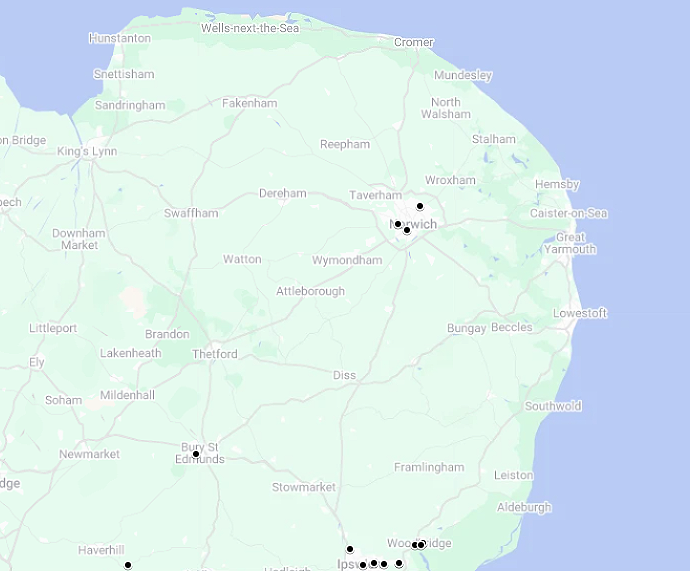
The map below shows homes and sites across Norfolk where we have acted as party wall surveyors.
Need advice before works begin? Contact Meon Surveyors for free, no-obligation guidance from an experienced party wall surveyor.
Where we operate in Norfolk
Choose your town for local party wall guidance. Towns are grouped by the four new council areas that take over in April 2028, with today’s council names shown so you can find yours either way.
North and east Norfolk
North Norfolk District Council and Great Yarmouth Borough Council
Don’t see your town? We cover the whole of Norfolk, including Sheringham, Holt, Hunstanton, Wells-next-the-Sea and the villages of the Broads. Get in touch and we’ll be happy to work with you.
Meet the Senior Team
Our team of skilled party wall surveyors is dedicated to providing expert assistance tailored to your needs.

-
Director
Meon’s principal Party Wall Surveyor - Jason graduated with a BSc (Hons) in Building Surveying and has since worked as a Party Wall Surveyor for over 10 years. Jason is a member of the The Faculty of Party Wall Surveyors, the Pyramus & Thisbe Society and an Associate Member of the Chartered Association of Building Engineers.
Jason has experience in a vast range of projects from commercial developments, multi-units residential schemes, new builds, education sector for the DfE and residential extension and loft conversions throughout England and Wales.

-
Director
Meon’s co-director - Mathew started his career in construction in Quantity Surveying graduating with a BSc (Hons) in Quantity Surveying.
Prior to turning his expertise to specialising in Party Wall Surveying and Neighbourly Matters, Mathew worked as a senior estimator for one of the UK’s leading house builders on schemes upto 1000 units.
Mathew has a wealth of experience on residential and commercial schemes ranging from extensions, loft conversions and refurbishments to large multi units sites.
Building work coming up in Norfolk?
Talk to us before work starts, whether you need to serve notice or a neighbour’s notice has just landed on your doormat. We’ll set out what the Act requires for your project and give you a clear quote.