
Party Wall Surveyors in Suffolk
Party wall surveying for homeowners and builders across Suffolk, from the county town of Ipswich to the market towns of the west and the Heritage Coast.
Planning an extension in Ipswich, a loft conversion in Lowestoft or work beside a timber-framed cottage in the Stour Valley? Meon Surveyors acts on party wall matters across the whole of Suffolk. We are appointed by building owners who need to serve notice before they start, and by adjoining owners who want their home looked after while the work next door goes ahead.
The Party Wall etc. Act 1996 works the same way in Felixstowe as it does in Haverhill. What changes across Suffolk is the building stock, the ground and what is happening nearby. This is a county with one of England’s richest stocks of medieval timber-framed buildings, a coastline that is still retreating, and one of the biggest construction projects in the country on its doorstep. Those local factors shape how each appointment is handled.
Party walls across Suffolk
Suffolk is mostly rural, with its larger towns spread out rather than clustered. Ipswich, the county town, sits at the head of the Orwell estuary. Felixstowe, home to Britain’s busiest container port, lies at its mouth. Lowestoft, the most easterly town in the UK, anchors the north of the county. To the west are Bury St Edmunds, Newmarket, Haverhill and the Breckland towns of Brandon and Mildenhall. In between are dozens of small market towns and villages.
That spread gives a wide mix of party wall work. Ipswich and Lowestoft have long runs of Victorian and Edwardian terraces, where loft conversions and rear extensions are routine. Felixstowe, Kesgrave and Haverhill grew quickly in the twentieth century, so semis and short terraces from the 1930s to the 1980s are common there. In Sudbury, Woodbridge and Bury St Edmunds, many town-centre buildings are hundreds of years old, often with a later brick front added to a much older timber frame behind.
Suffolk’s councils were due to be reorganised too. In March 2026 the Government chose a model of three unitary councils for the county, but it withdrew that decision on 7 September 2026 while it reviews reorganisation nationally. For now, Suffolk County Council and the five district and borough councils carry on as before. None of this affects party wall matters, which are a private process between neighbours and do not involve the council.
Unsure of whether you need a party wall surveyor? Use our free tool, or get in touch with us today for a no-obligation chat.
What makes party wall work in Suffolk different
Old buildings, and lots of them
Suffolk has around 13,300 listed buildings, according to Historic England’s National Heritage List, and more than 300 of them are Grade I. Much of that wealth dates from the medieval wool trade, which left the county with timber-framed houses, guildhalls and merchants’ homes in towns such as Lavenham, Long Melford, Sudbury and Hadleigh. Babergh and Mid Suffolk alone have around 60 conservation areas.
Timber-framed party walls behave very differently from brick. They flex and settle, are often filled with lath and plaster or wattle and daub, and can be badly damaged by work that would be routine on a modern house. Shared walls may also have been altered many times over the centuries, so the real line between two properties isn’t always where it appears. Work next to them needs careful recording beforehand and a method that suits the building. Listed building consent is a separate requirement and doesn’t replace a party wall award.
Mixed ground, from boulder clay to sand and crag
Much of central and western Suffolk, known as High Suffolk, is covered by chalky boulder clay left by glaciers. Like other clays, it shrinks in dry summers and swells in wet winters. Around Ipswich and along the Orwell, Deben and Stour estuaries, London Clay lies close to the surface. The east has sandy soils and the shelly sands known as crag, while the Brecks in the north-west sit on sand over chalk.
Ground can change within a single street. That affects how deep new foundations need to go, and therefore whether an extension falls under the Act’s excavation rules near a neighbour’s building. On clay, a schedule of condition taken before work starts is especially useful, because older houses often have seasonal cracking that opens and closes through the year.
A coast that is still moving
Parts of the Suffolk coast are eroding quickly. At Thorpeness, East Suffolk Council recorded faster erosion between December 2024 and April 2025, and four clifftop homes were demolished between October 2025 and January 2026, adding to one removed in 2022. In January 2026 the council agreed to cover homeowners’ demolition costs while it seeks government reimbursement. Erosion is a long-running issue at Pakefield, Covehithe and Dunwich too.
Coastal erosion isn’t a party wall matter in itself. But along the coast, any building work near a neighbour, such as underpinning, new foundations or a replacement wall, needs extra care to ground conditions and drainage. A thorough record of the neighbouring property’s condition matters more here than in most places.
Sizewell C and growth around Ipswich
Construction of the Sizewell C nuclear power station near Leiston passed its two-year mark in January 2026, with almost 2,000 people working on site. The project is bringing new roads, including two A12 roundabouts at Yoxford and Friday Street due this year, and steady demand for housing and building work in the surrounding towns. Sizewell C works under its own development consent, not the Party Wall Act, but the homes and businesses around it are extending and converting at a busy pace.
Closer to Ipswich, two large new neighbourhoods are taking shape. At Brightwell Lakes in Martlesham, next to Kesgrave, a community of 2,000 homes is being built over about 17 years, with a new primary school due in September 2027. On the northern edge of Ipswich, the Ipswich Garden Suburb has outline permission for 1,915 homes, and in January 2026 the council resolved to approve a further phase of up to 1,020 homes at Red House. Across the county, councils began work on new local plans to 2045 in 2026, so the pressure to build looks set to continue.
Some of our previous Party Wall projects in Suffolk
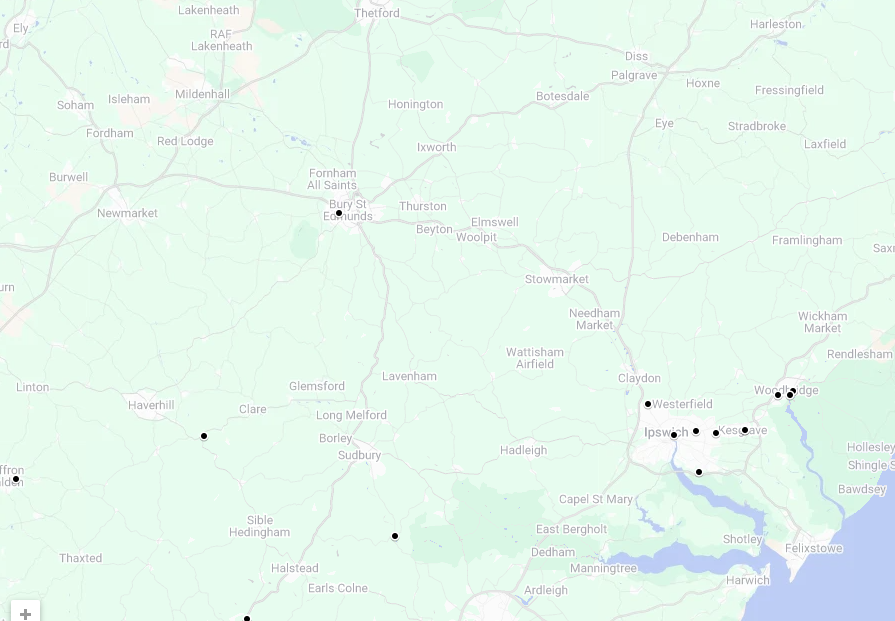
The map below shows homes and sites across Suffolk where we have acted as party wall surveyors.
Need advice before works begin? Contact Meon Surveyors for free, no-obligation guidance from an experienced party wall surveyor.
Where we operate in Suffolk
Choose your town for local party wall guidance. Towns are grouped by the four new council areas that take over in April 2028, with today’s council names shown so you can find yours either way.
Ipswich and south and central Suffolk
Ipswich Borough, Babergh District and Mid Suffolk District councils
East Suffolk and the coast
East Suffolk Council
Don’t see your town? We cover the whole of Suffolk, including Leiston, Hadleigh, Southwold, Framlingham and the villages in between. Get in touch and we’ll be happy to work with you.
Meet the Senior Team
Our team of skilled party wall surveyors is dedicated to providing expert assistance tailored to your needs.

-
Director
Meon’s principal Party Wall Surveyor - Jason graduated with a BSc (Hons) in Building Surveying and has since worked as a Party Wall Surveyor for over 10 years. Jason is a member of the The Faculty of Party Wall Surveyors, the Pyramus & Thisbe Society and an Associate Member of the Chartered Association of Building Engineers.
Jason has experience in a vast range of projects from commercial developments, multi-units residential schemes, new builds, education sector for the DfE and residential extension and loft conversions throughout England and Wales.

-
Director
Meon’s co-director - Mathew started his career in construction in Quantity Surveying graduating with a BSc (Hons) in Quantity Surveying.
Prior to turning his expertise to specialising in Party Wall Surveying and Neighbourly Matters, Mathew worked as a senior estimator for one of the UK’s leading house builders on schemes upto 1000 units.
Mathew has a wealth of experience on residential and commercial schemes ranging from extensions, loft conversions and refurbishments to large multi units sites.
Building work coming up in Suffolk?
Talk to us before work starts, whether you need to serve notice or a neighbour’s notice has just landed on your doormat. We’ll set out what the Act requires for your project and give you a clear quote.