
Party Wall Surveyors in Cambridgeshire
Party wall surveying for homeowners and builders across Cambridgeshire, from historic Cambridge to Peterborough and the towns of the Fens.
Extending a Victorian terrace in Cambridge, adding a storey in Peterborough or underpinning a cottage in the Fens? Meon Surveyors acts on party wall matters anywhere in Cambridgeshire. We are appointed by building owners who need to serve notice before work starts, and by adjoining owners who want their home looked after while a neighbour builds.
The Party Wall etc. Act 1996 is the same in Wisbech as it is in St Neots. What changes is the ground, the age of the buildings and the pace of development. Cambridgeshire combines one of the fastest-growing cities in the country with some of the softest, most shrinkable ground in England.
Party walls across Cambridgeshire
Cambridgeshire has two cities. Cambridge, in the south, is a world-renowned university city surrounded by fast-growing villages and new communities. Peterborough, in the north, is a larger, faster-growing city with a cathedral at its heart and estates built when it became a new town in the 1960s and 1970s. Between them sit Huntingdon, St Ives and St Neots along the Great Ouse, the cathedral city of Ely, and the Fenland market towns of March, Wisbech, Whittlesey and Chatteris.
Party wall work here ranges widely. Cambridge has dense Victorian terraces in Mill Road, Romsey and Chesterton, where loft conversions and side-return extensions are routine, plus a large stock of listed and historic buildings. Peterborough has older terraces near the centre and new-town estates around it. In the Fenland towns, Georgian streets in Wisbech and older brick terraces in March and Chatteris sit on ground that moves more than almost anywhere else in the county.
Unsure of whether you need a party wall surveyor? Use our free tool, or get in touch with us today for a no-obligation chat.
What makes party wall work in Cambridgeshire different
Fen peat and shrinking clay
The Fens were drained from the seventeenth century onwards, and the peat that was exposed has been shrinking and wasting away ever since. Many Fenland houses were built on shallow footings, and some lean noticeably as the ground beneath them has settled. Around Cambridge and in the west of the county, Gault and Oxford Clay take over, both of which swell in wet weather and shrink in dry spells, especially near trees.
Soft ground usually means deeper foundations, piles or rafts for new building, which often brings excavation near a neighbour within the Act. It also means existing cracking is common, so a detailed schedule of condition before work starts is particularly important here.
Historic Cambridge and Ely
Cambridge’s centre is full of listed buildings and conservation areas, and Ely’s cathedral quarter is similar. Old party walls in these streets are often soft brick or clunch laid in lime mortar, sometimes with timber framing behind. They need careful handling, and listed building consent or conservation area rules are a separate requirement from any party wall award.
Peterborough’s new-town estates
Peterborough was designated a new town in 1967, and its population roughly doubled over the following decades as townships such as Bretton, Orton and Werrington were built around the old city. Many of those homes are terraces and link-detached houses, some of them built with timber frames or other non-traditional methods. Before new steelwork or openings go into a shared wall, it’s worth checking exactly how that wall was built, because it may not be solid masonry.
Closer to the centre, Peterborough’s Victorian terraces around Millfield and New England are regularly extended and converted, which brings the usual loft and rear-extension notices.
Growth constrained by water
Greater Cambridge is planning for major growth. The updated Greater Cambridge Local Plan, published in July 2026, plans for over 50,000 new homes between 2024 and 2045, around 37,000 of which already have permission or allocations. The final consultation ran from August to September 2026, with submission to the Government expected at the end of the year. Water supply is a real limit: Cambridge is in one of the driest parts of England, and new homes depend on infrastructure such as the planned Fens Reservoir.
Big new communities such as Waterbeach, Northstowe and Cambourne are rarely party wall matters themselves. But the extensions, conversions and infill that come with a growing city very often are.
Some of our previous Party Wall projects in Cambridgeshire
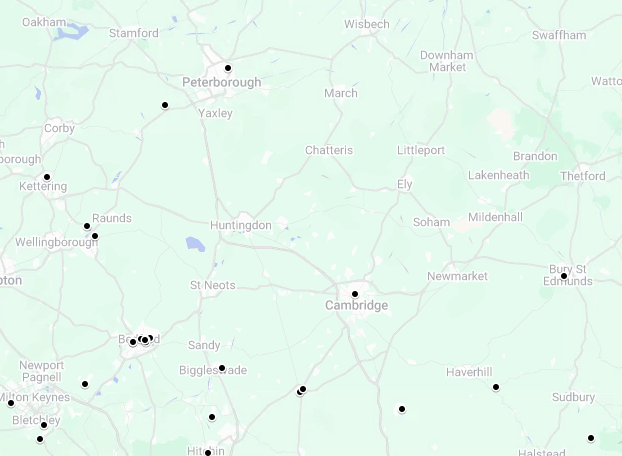
The map below shows homes and sites in the Cambridgeshire area where we have acted as party wall surveyors.
Need advice before works begin? Contact Meon Surveyors for free, no-obligation guidance from an experienced party wall surveyor.
Where we operate in Cambridgeshire
Choose your town for local party wall guidance. Towns are grouped by area, with the local council for each group shown underneath.
Don’t see your town? We cover the whole of Cambridgeshire, including Ramsey, Cambourne, Northstowe and the villages around Cambridge. Get in touch and we’ll confirm.
Building work coming up in Cambridgeshire?
Talk to us before work starts, whether you need to serve notice or a neighbour’s notice has just landed on your doormat. We’ll set out what the Act requires for your project and give you a clear quote.